The importance of time in networks

Last week saw a major incident for an Australian telco that literally stopped trains, business, and other services across Australia. After a week it was revealed that the company’s internal time servers had not been well maintained, and flipped over 19.x years of uptime, causing them to warp back in time20 years.

Apparently it was a known issue; engineers had warned about it, the vendor had many outstanding updates to be applied. But these devices had just been kept up and running.

There were multiple of them, but when operations teams are stripped down, clearly what should be essential maintenance just doesn’t happen.

The original Network Time Protocol (NTP, and the newer Precision Time Protocol (PTP) is one that often originates from atomic clocks. One readily available source is from GPS satellites, happily blasting the time across your location routinely. These days that’s also joined by Europe’s Galileio, the Russian GLONASS, and CHina’s BeiDou.

And while you think the correct time is universal these days (check your mobile/cell phone – you probably find it has the right time), these signals are often jammed and interferredwith by various national entities during conflicts and other activities to confuse positioning systems. Yes, it’s like the plot of James Bond’s Tomorrow Never Dies.

In every network I have ever had, pre cloud or post cloud, having a reliable source of time was always critical. Logs must line up to the millisecond, if not then more precise than that.

Having scalable time services is even more important, because at scale you are relying on correct time even more. Most network operators normally have multiple time servers, listening to upstream time providers, locate din different buildings, on different UPS, or in different data centers, etc..

In order to protect their primary time servers, organisations then have a second level of server, available to clients – these are the only ones that can talk tot he primary server. If you’re using NTP, then the Stratum number will help show this, as eveerly level down (away) from the atomic clock is a higher stratum:

  • Stratum 0: the atomic clock
  • Stratum 1: the server physically wired to the atomic clock
  • Stratum 2: downstream from the Stratum 1 servers
  • etc….

On my small Debian system, I have the SystemD NTP service (timesyncd) that is listening, and I can see from the comment timedatectl show-timesync the current status:

# timedatectl status
Local time: Mon 2026-07-13 22:51:00 AWST
Universal time: Mon 2026-07-13 14:51:00 UTC
RTC time: Mon 2026-07-13 14:51:00
Time zone: Australia/Perth (AWST, +0800)
System clock synchronized: yes
NTP service: active
RTC in local TZ: no
# timedatectl show-timesync
FallbackNTPServers=169.254.169.123 fd00:ec2::123
ServerName=fd00:ec2::123
ServerAddress=fd00:ec2::123
RootDistanceMaxUSec=5s
PollIntervalMinUSec=32s
PollIntervalMaxUSec=34min 8s
PollIntervalUSec=34min 8s
NTPMessage={ Leap=0, Version=4, Mode=4, Stratum=3, Precision=-18, RootDelay=198us, RootDispersion=335us, Reference=A9FEA97A, OriginateTimestamp=Mon 2026-07-13 22:39:05 AWST, ReceiveTimestamp=Mon 2026-07-13 22:39:05 AWST, TransmitTimestamp=Mon 2026-07-13 22:39:05 AWST, DestinationTimestamp=Mon 2026-07-13 22:39:05 AWST, Ignored=yes, PacketCount=1166, Jitter=489us }

Here my internal NTP daemon is a Stratum 3, which means there is a Stratum 2 and 1 above me. IN this case, you can also see the address being used: 196.254.169.123 – which is the AWS Time Sync Service, a scalable time source across the entire EC2 fleet. In pre-cloud days, I would have two or more NTP hosts exchanging NTP traffic direct to upstream peers, and then have hundreds of servers query those three.

I would also have monitoring on those to ensure that the the three had a reasonably consistent view of the current time, and were not drifting off into the past (or future).

And lastly, the NTP software would be some of the core packages to get routine package updates to address vulnerabilities and bugs over time. You would do these one at a time, to ensure the other NTP servers remained available, and the one being updated had time to reconnect, sync up, and start having (even network-internal) clients use it.

Not maintaining hardware (firmwares) is a clear piece of not taking the responsibility for basic operational defence of these systems. Once upon a time (30+ years ago) a long “system uptime” was an admired feat of endurance. For the last decade, I looking at the age of your software (and firmware) to determine the oldest pieces and prioritising everything having a low median age is a better measure. Something that has been unpatched, but still running, doesn’t mean it is secure and reliable. If it hasn’t been restarted in the last year, do you know if it can restart after a power outage? Does it have patches that are not yet available? We know that cryptographic support changes over time (see TLS 1.3), but so has basic networking addressing protocols (see the IPv4 and IPv6 changes).

A ton of IPv6 innovations in AWS

The last three months have seen a large number of IPv6 announcements from AWS. I’ll recount some of them here:

  • Organisations support IPv6 (link)
  • IPv6 for EC2 public DNS names (link)
  • Transfer family supports IPv6 (link)
  • Managed Service for Apache Fink adds IPv6 (link)
  • Resource Groups adds IPv6 support (link)
  • EFS supports IPv6 (link)
  • EFS supports IPv6 (link)
  • Private CA supports IPv6 (link)
  • Site-to-Site VPN supports IPv6 on outter tunnel endpoints (link)
  • DataSync supports IPv6 (link)
  • SNS expands IPv6 support to include VPC endpoints (link)
  • SQS expands IPv6 support to include VPC endpoints (link)
  • CloudWatch adds IPv6 support (link)
  • EventBridge supports IPv6 (link)

Much of the public (Internet) facing endpoints for these services are now dual-stack, supporting both IPv4 and IPv6 (for now).

But have a think about the VPC endpoints that are now either dual stack, or IPv6 only: this increases the direct integrations for potential IPv6 only subnets, or massive sizes, to integration endpoints such as SQS and SNS. These scale-out VM farms can now have these loosely coupled integrations that can support the sale of millions of virtual machines; the rest of the VPC may be on traditional IPv4 only allocations, but having that layer of messaging is now highly valuable.

We’re at a point now where it is almost commonplace for dual-stack endpoints for most AWS cloud services; and it should be the same for endpoints that customers make on the AWS cloud. There’s very little holding you back – certainly not cost, and in some cases, cost is (or will likely be) the driving factor for the rapid uptake of IPv6, for those that are ready.

Amazon SQS adds IPv6 support

At first glance, this seems like a strange thing to be even mildly excited about.

AWS has been added “dual stack” (having both IPv4 and IPv6 addresses) for their services for some time, and I have blogged about this many times over.

First, lets just go read the brief release, from April 21 of 2025 https://aws.amazon.com/about-aws/whats-new/2025/04/amazon-sqs-internet-protocol-version-6/.

OK, you’re back. First up, how is this working?

Well, the existing API endpoints, such as service.region.amazonaws.com have been extended with a new TLD. While amazonaws.com still exists in documentation, I discovered that dual-stack endpoints are on a different domain (docs), “api.aws”:

{protocol}://{service-code}.{region-code}.api.aws

While most services do not respond to ping, its a handy way of doing a DNS resolution:

> ping -6 sqs.ap-southeast-2.api.aws

Pinging sqs.ap-southeast-2.api.aws [2406:da70:c000:40:e3db:e3b2:7e93:ef41]

Your library (eg, boto) may not be up to date with this change, and even then, this new endpoint may not be in use.

Pro Tip: always update your boto library.

So why is this useful?

Let’s say you have a workload that uses SQS, running from your existing data centre, on a traditional IPv4-only network. Your application uses SQS as a fan out mechanism to despatch jobs to a fleet of worker nodes. Historically, this set of worker nodes, when listening to SQS for messages, would have had to all used IPv4; now they can exist on IPv6 only networks, and still receive their messages.

In effect, SQS as a control mechanism can now also be a bridge between hosts on either IPv4 or IPv6.

I’ve been championing the use of IPv6 with, in and on AWS since 2012; this year (2025) has continued to see additional services – like this – step up to include seamless dual-stack capability. At some stage, this will become table-stakes, required on service launch, and not a future service innovation.

TCS is now the world’s largest AWS Consulting Services Partner, by count of AWS Certifications

It’s taken a long time, but the top of the chart of AWS Cloud consulting services partners has had a shake up on the leader board.

It’s not scientific, and could mean nothing, but I have been tracking the reported number of AWS Cloud certifications across the AWS Partner Community for a while now. It is a limited view into the commitment of these organisations to get their staff knowledge validated, at some level. That level could be Foundational (and thus non-technical), or it could be through to specialist. And for the last few years, the worlds largest partner by this metric has been Accenture.

But not today.

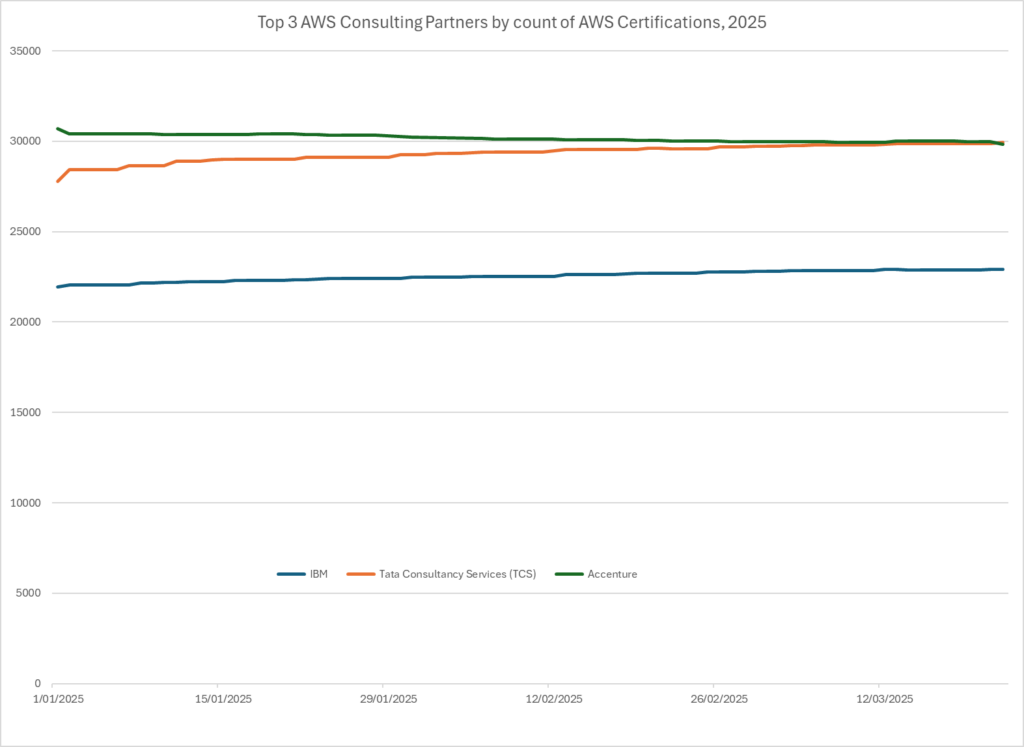
Today, Tata Consulting (TCS) overtook Accenture. Here’s the plot per day since the start of 2025, and the orange line (TCS) has just poked through the green line (Accenture):

TCS now stands in 1st spot with 29, 947, compared to 29,845 for Accenture, a gap of 102 AWS Cloud certifications.

Yesterday, Accenture was still in front on 29,983, and TCS was just 113 behind.

At it’s peak, Accenture could talk of more than 36,000 AWS Certifications. But in the recent past, this number has been steadily declining, while TCS and the rest of the providers have generally been ascending.

I have not seen any indication why Accenture’s total attributed AWS Certifications have been dropping. Perhaps a policy on paying the charges for their staff for re-certifications, perhaps staff attrition, mergers and de-merges. Perhaps a bunch of people who achieved the Cloud Practitioner (non-technical) 3 years ago as some initiative changed focus and let them expire.

Either way, it seems that the focus and drive that Accenture had shown, is not matched by the focus of TCS.

Does this matter in the AWS Cloud partner ecosystem? Perhaps not. But I find it interesting to consider.

AWS Cloud Certifications in the Partner Community, 2024

I track the capability of the consulting services partners by a number of attributes. Here is what the top 9 look like, by count of AWS Certifications, for the last two years until November 2024:

A bit of a gap on Accenture data, but still interesting

It appears that Accenture is ín danger of losing its dominant position as the worlds largest AWS Cloud consulting services partner, perhaps sometime in the next three to six months; TCS is accelerating up from what was 6th position in 2022, currently in 2nd position.

It appears that DXC was lagging the others, but has now caught back up.

Now lets look at an aggregate total of the top 20 partners’ certifications, excluding Accenture (due to missing data), and see what the ecosystem growth is like:

This looks like there is continuing growth of the number of certs held, growing 57.3% over two years.

Looking at the AWS Partner Competencies achieved for those top 9 (by certifications held) :

Accenture continues to lead

I find it interesting to derive the focus and attention these organisations are placing on their AWS Cloud skills validation in their workforce.

For many of these, the long trail is the set of individuals who only hold the one certification, which often is the Cloud Practitioner – Foundational cert. This level of validation is aimed at being non-technical, often achieved by sales, marketing, and management folk who do not have the delivery capability to competently deploy a Lambda function or set a security group! However, its beyond my visibility to be able to remove this cert from the totals I can see. This means that the true delivery capability may be very different for these organisations.